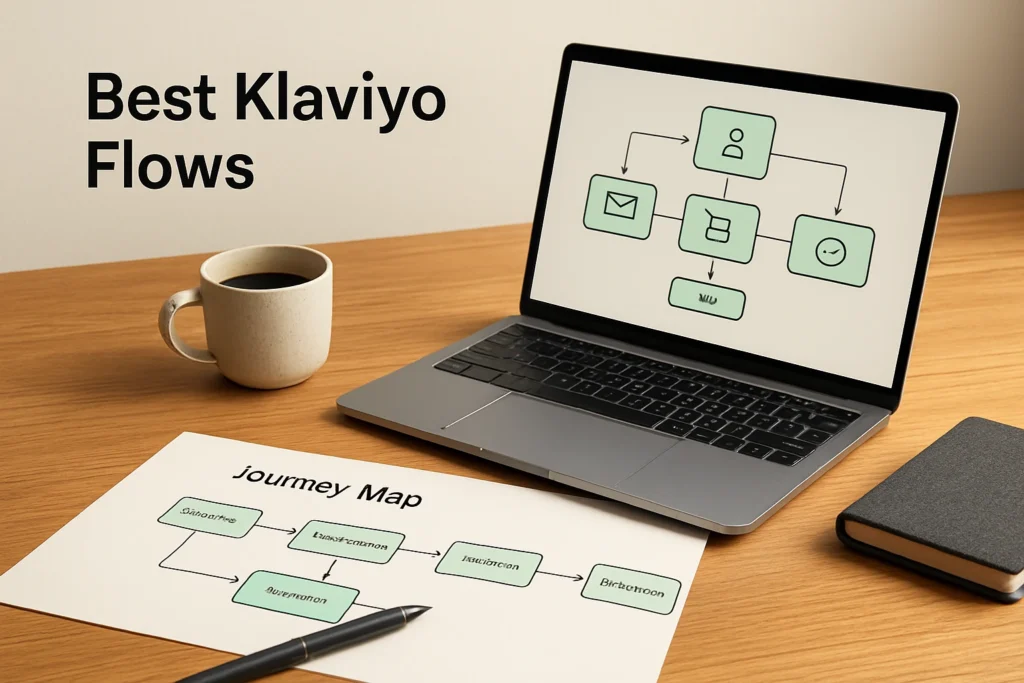
The best Klaviyo flows cover four lifecycle needs: welcoming new subscribers, recovering active purchase intent, supporting customers after an order, and re-engaging people whose activity has declined. Start with the journeys supported by dependable profile, consent, behavioral, and transaction data. A sophisticated automation built on missing events or unclear permissions is less useful than a simple flow with a valid trigger, a focused purpose, and a tested exit condition.
Prioritize the best Klaviyo flows by customer intent
A practical implementation order is welcome, cart or checkout abandonment, post-purchase, and win-back. This sequence establishes a broad acquisition journey first, addresses high purchase intent next, and then extends automation into retention. Add browse abandonment or replenishment only when your store supplies the required activity or product-lifecycle data consistently.
- Audit available signals. Identify which profile, subscription, consent, engagement, browsing, cart, checkout, and purchase data actually reaches Klaviyo.
- Build the welcome series. Give newly eligible subscribers a clear route from signup to product discovery or a first purchase.
- Add the strongest supported abandonment journey. Prefer the latest reliable stage in the buying process, such as checkout activity, without assuming every store records the same events.
- Create post-purchase support. Use transaction and product context to help customers succeed after ordering.
- Define win-back eligibility. Target customers whose inactivity meets a business-relevant threshold, not everyone who missed a recent campaign.
- Test entry and exit behavior. Confirm that a qualifying profile enters once as intended and that purchase, renewed engagement, or loss of consent changes subsequent messaging appropriately.
| Flow | Required signal | Lifecycle goal | Priority |
|---|---|---|---|
| Welcome series | Eligible new subscriber and recorded channel permission | Turn initial interest into product discovery or a first purchase | Build first |
| Cart or checkout abandonment | Reliable cart or checkout activity without a subsequent purchase | Help a high-intent shopper resume the buying journey | Build after welcome |
| Post-purchase | Recorded transaction plus useful order or product data | Set expectations, improve product use, and support retention | Build once purchase data is dependable |
| Win-back | Meaningful period without a purchase or selected engagement | Re-establish relevance or reduce unnecessary messaging | Build after core journeys |
Build a Klaviyo welcome series that creates momentum
A Klaviyo welcome series should begin when a new subscriber becomes eligible for the intended channel. Subscription status and consent need to be usable in the audience logic; a form submission or imported profile should not automatically be treated as permission for every channel.
Give each message one job. The opening message should establish what the brand offers and provide an immediate next step. A second message can guide the subscriber toward useful products, categories, or educational material. A later follow-up can address a common decision barrier or provide a time-bounded reason to return when that approach fits the offer.
Use profile characteristics, engagement, and purchase activity to keep the journey relevant. A first-time buyer may no longer need introductory purchase persuasion, while an engaged non-buyer may benefit from more specific product guidance. Klaviyo supports rule-based segments that update as qualifying profile data and activity change, making those distinctions useful for audience design.
An illustrative welcome workflow
- A visitor subscribes to email and becomes eligible for the welcome audience.
- The first message introduces the brand promise and directs the subscriber to a relevant category.
- The next message provides category guidance or explains how to choose among products.
- A final follow-up gives the subscriber a clear reason and route to continue shopping.
Suppose the subscriber opens the introduction and visits a category but does not purchase. An illustrative refinement would replace a repeated brand overview with practical category-selection guidance. The identifiable weakness is insufficient help choosing, so the follow-up should solve that problem rather than merely repeat the original call to action.
Check whether eligible subscribers enter the sequence, whether they engage with the intended destination, and whether first-purchase activity follows. Treat those signals as diagnostic information rather than proof that one message caused the purchase.
Recover purchase intent with abandonment flows
Browse, cart, and checkout abandonment represent different levels of intent. They should not be combined into one generic trigger unless the underlying data genuinely supports that interpretation.
- Browse abandonment starts from recorded product or category activity without stronger buying behavior. It is useful only when browsing events and profile identification are dependable.
- Cart abandonment requires a reliable signal that products were added or retained in a cart.
- Checkout abandonment depends on recorded checkout progress without a later purchase and generally represents the strongest intent of the three.
Use the latest trustworthy event rather than creating every possible version immediately. Where product or category fields are available in the customer data, personalization can reconnect the message to the shopper’s activity. If that context is incomplete, use a reliable route back to shopping instead of inserting uncertain product details.
Timing should reflect purchase complexity and normal consideration time. A routine consumable and an expensive considered purchase should not automatically receive the same sequence. Avoid overlapping recovery messages from browse, cart, and checkout journeys by defining which signal takes precedence.
The critical safeguard is purchase exclusion. Configure the audience conditions so a recorded purchase makes the customer ineligible for remaining recovery messages. Test this with a controlled profile: enter the journey, record a purchase through the connected commerce process, allow the data to reach Klaviyo, and confirm that the next promotional recovery message is not sent.
Use post-purchase automation to strengthen retention
Post-purchase communication should help customers receive value from what they bought. Keep it distinct from operational order confirmations unless your transactional process and permissions explicitly support the intended use.
Begin with expectation-setting or product education that complements the order. Follow with setup, care, or usage guidance when it reduces customer effort. Request a review or feedback only after the buyer has had a reasonable opportunity to use the product. Cross-sell recommendations should solve a related need rather than promote an unrelated item immediately after purchase.
Replenishment is appropriate only when the product has a credible repeat-use cycle and the store data identifies what was purchased. Durable goods, gifts, subscriptions, and consumables require different logic. Use transaction details and relevant profile data to define audiences instead of applying one replenishment interval across the catalog.
A successful post-purchase check is operational as well as commercial. Confirm that purchasers enter with the correct order context, receive relevant education, and leave product-specific sequences when the underlying conditions no longer apply. Then examine repeat purchases, feedback activity, unsubscribes, and support patterns for signs that the journey helps rather than adds friction.
Re-engage customers without overmailing them
A win-back flow needs a meaningful inactivity definition. Purchase frequency, product lifespan, engagement history, and normal consideration time should influence eligibility. A customer who buys twice a year should not necessarily be treated as lapsed after several weeks.
Use real-time segmentation to distinguish previously active customers from people who have never meaningfully engaged. The first message can remind the customer of relevant value, while a later message can offer preference choices or a lower communication frequency. An incentive is a strategic option, not a requirement.
Set clear exits. A new purchase, renewed qualifying engagement, an audience change, or withdrawal of consent should alter or end subsequent messaging as appropriate. This prevents the flow from continuing after it has achieved its purpose or lost permission to use a channel.
Measure and improve each Klaviyo automation
Evaluate each flow against its lifecycle goal using first-party store outcomes and communication data. Klaviyo provides campaign metrics and reporting, while the business must decide which measures represent useful progress and how attribution will be interpreted.
- Entry quality shows whether qualifying people enter and whether unrelated profiles are being included.
- Delivery and engagement help identify technical problems, weak relevance, or message fatigue.
- Store outcomes include first purchases, completed checkouts, repeat purchases, or other actions tied to the flow’s purpose.
- Negative signals include unsubscribes, consent changes, and repeated non-engagement.
- Exit accuracy confirms that customers stop receiving messages when they purchase, re-engage, or become ineligible.
Use one consistent attribution approach when comparing periods or flows. Vendor-attributed revenue is an estimate shaped by the selected rules and available data, not a guaranteed incremental result. Compare a flow with its own historical performance and relevant customer groups before treating a difference as meaningful.
Change one major variable at a time, such as audience definition, delay, message purpose, or channel. Record the change and compare compatible periods. If entry volume suddenly falls, inspect source events and audience conditions before rewriting content; if entry remains stable but engagement declines, examine relevance, repetition, and frequency.
Choose the next flow from the data you can trust
Map the four core journeys against the events, profile fields, transaction records, and consent information currently available in Klaviyo. Build the highest-priority flow whose entry and exit conditions you can test from end to end. Once it operates reliably, use actual customer behavior to decide whether the next investment should be deeper conversion recovery, stronger post-purchase education, or more selective re-engagement.
Explore more technology guides on Techistuff.
Frequently Asked Questions About Klaviyo flows
Which Klaviyo flows should I create first?
Begin with a welcome series, then add the highest-intent abandonment flow supported by your store data. Follow with post-purchase support and a win-back flow. This order covers acquisition, conversion recovery, retention, and re-engagement while giving the team time to validate triggers, consent rules, exclusions, and source data.
How long should a Klaviyo welcome series be?
There is no universal message count. Use the shortest sequence that introduces the brand, helps subscribers find a relevant product or category, and provides a sensible next step. Start with roughly three distinct message jobs, then shorten, extend, or branch the journey according to engagement and first-purchase behavior.
What is the difference between a Klaviyo flow and a campaign?
A flow is an automated sequence that responds to configured customer activity, audience conditions, or available profile data. A campaign is a one-time communication sent to a selected audience. Flows suit recurring lifecycle moments, while campaigns suit launches, announcements, promotions, and other scheduled messages.
Should every ecommerce store use SMS in its automations?
No. Use SMS only when the business has appropriate channel consent, a suitable message, and access to the required product in its region. Klaviyo treats mobile messaging as a separate subscription, and availability and rates can depend on region, channel, number type, and message segments. Email-only flows can still cover the lifecycle.
How do I stop abandonment messages after a purchase?
Make the purchase signal part of the recovery flow’s continuing eligibility logic. Test with a controlled profile that enters the journey and then records a purchase. The success condition is that remaining promotional recovery messages are no longer sent after the purchase data reaches Klaviyo.