
Overview
Pipedream is an automation and integration platform designed for developers building API-connected products, internal systems, and AI agents. Its current Connect offering gives an application access to managed authentication, prebuilt actions, event triggers, and custom API requests across a large connector catalog. Rather than acting as a standalone no-code application builder, it supplies integration infrastructure that teams embed through SDKs or a REST API.
That distinction matters when deciding what Pipedream should replace. It can reduce the work involved in authenticating users and connecting external services, but it does not remove the need to design application logic, map data, handle failures, and control access. The plan details, production restrictions, credit model, and verified integrations elsewhere on this page define the commercial and technical boundaries.
How Pipedream workflows connect APIs and services
A Pipedream integration usually begins inside the developer’s application. The application uses a supported SDK or the Pipedream API to create and manage Connect resources, present an authentication flow, or invoke a tool associated with a connected service. TypeScript, Python, and Java SDKs are available alongside the REST API, giving teams several ways to fit Connect into an existing backend.
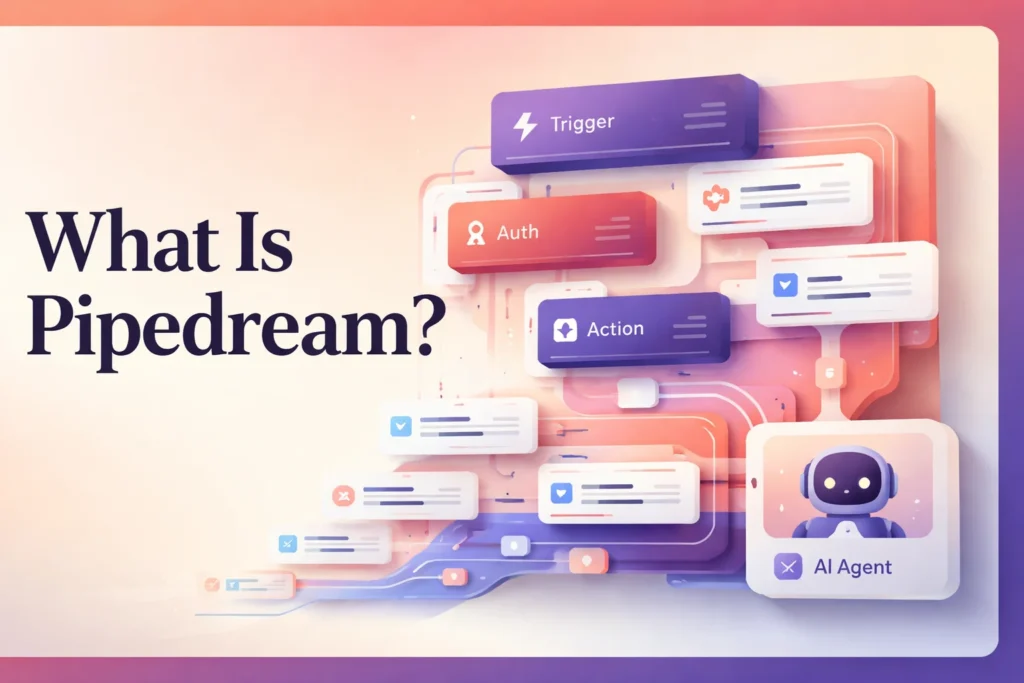
The basic execution pattern remains trigger-to-action automation, even when the implementation is embedded rather than assembled on a visual canvas. An event trigger can notify the application that something happened in a connected service. The application can then validate the event, transform its data, apply business rules, and call one or more actions. For integrations that are not fully represented by a prebuilt action, the Connect proxy can issue a custom request to the service’s API using managed credentials.
Authentication is central to this model. Pipedream supports OAuth and API-key connections, hosted Connect Link flows, and custom OAuth clients. It encrypts credentials at rest, scopes them by project, and automatically refreshes supported tokens. The application still decides which account a connection belongs to, what permissions to request, and when an authenticated operation is allowed.
Native connections and custom API access solve different problems. A prebuilt action packages a common operation behind a defined interface, reducing the amount of service-specific request code. A proxy request offers more flexibility but requires the developer to understand the destination API, including its endpoints, payloads, permissions, and response formats. MCP servers and tool calls extend the same integration layer to compatible AI-agent scenarios.
Connect should also be distinguished from the legacy Pipedream Workflows product, which is in maintenance mode and scheduled to shut down on March 31, 2027. Connect is not affected. New evaluations should therefore focus on whether an embedded integration layer fits the application, rather than assuming the older workflow-building experience represents the current core product.
What users need to configure and maintain
Pipedream manages connector infrastructure, supported authentication flows, encrypted credential storage, and automatic token refresh. The customer remains responsible for integrating the SDK or API into server-side code, associating connections with the correct users, choosing permissions, and enforcing application-level authorization. A successful OAuth connection does not by itself establish that every user should be allowed to run every available action.
Data mapping also stays with the implementation team. Fields returned by one API rarely match the inputs expected by another, so developers need to validate types, normalize identifiers, handle missing values, and decide which data can cross system boundaries. Connect does not store API request payloads or response bodies, making the application’s own observability and retention design important where teams need diagnostic records or audit evidence.
Failure handling should be explicit. Applications need policies for rate limits, expired permissions, unavailable endpoints, duplicate events, partial completion, and malformed responses. Depending on the integration, this may involve retries, idempotency controls, alerts, or a queue for work that cannot complete immediately. These policies should be tested with development connections before production access is enabled.
Connected services also evolve independently. Teams should monitor API version changes, permission requirements, and connector behavior, then retest affected paths when a provider changes its contract. They also need to watch Pipedream usage credits and external-user counts because production activity beyond the included allowances creates additional charges. Forecasting should use realistic event volume and execution duration rather than connector count alone.
When Pipedream fits an automation project
Pipedream is strongest when API access is part of a product or technical service and the team wants to avoid building authentication and connector infrastructure for every provider. It suits projects whose developers are comfortable with backend integration, structured API data, permissions, and operational monitoring. The available proxy is particularly relevant when prebuilt actions cover common operations but the application also needs service-specific endpoints.
Expected production volume deserves early attention. Estimate active external users, action calls, proxy requests, MCP tool calls, and deployed-trigger events, then compare those assumptions with the included credits and overage model. Complex workflows should also be assessed for their application-side requirements, including branching logic, state, retries, and audit controls.
A team seeking primarily drag-and-drop business automation may be better served by evaluating a visual workflow automation platform. Organizations that need broader centralized governance across business systems may instead frame the decision around an enterprise automation platform. Pipedream is also not a complete app builder: teams still need their own interface, business logic, data model, and deployment environment. The deciding question is whether embedded API connectivity is the main problem to solve.
Key features
Embedded integration layer
Connect lets developers add integrations to applications and AI agents using managed infrastructure for more than 3,000 APIs.
Triggers and prebuilt actions
The catalog provides event triggers and packaged actions for common operations across supported services.
SDK and REST API access
Teams can work through TypeScript, Python, and Java SDKs or manage Connect resources through the REST API.
Managed authentication
Pipedream supports OAuth, API keys, hosted Connect Link flows, custom OAuth clients, encrypted credential storage, and automatic token refresh.
Custom API requests
The Connect proxy can make custom requests to connected services when a prebuilt action does not cover the required endpoint.
AI-agent connectivity
MCP servers and tool calls expose supported integrations to compatible agent implementations.
Project-scoped credentials
Credentials are encrypted at rest and scoped by project, while Connect does not retain API request payloads or response bodies.
Best use cases
Embed customer-facing integrations
Add authenticated connections to external services inside a software product without building every OAuth flow and connector independently.
Connect AI agents to tools
Expose supported application operations to compatible agents through MCP servers and tool calls.
Respond to service events
Receive deployed-trigger events and route them into application logic that validates, transforms, and acts on the data.
Reach custom API endpoints
Use the Connect proxy for authenticated requests when a required operation is not available as a prebuilt action.
Pricing
Prices are displayed in USD; United States applicability is not explicitly stated. Startup is also listed at a $99 monthly equivalent when billed annually. Additional external users cost $2 each per month, and additional usage costs $0.012 per credit. Actions, MCP tool calls, proxy requests, and deployed-trigger events generally use one credit per 30 seconds of compute.
Free
Startup — monthly
Startup — annual
Business
Pricing last verified 7 October 2026.
Important limitations
- Technical implementation required. The current Connect product requires server-side integration work, SDK or API configuration, and careful handling of identity, permissions, and application logic.
- Free access excludes production. The Free plan supports development, but deploying Connect for production use requires Startup or Business access.
- Variable usage charges. Costs can rise when an implementation exceeds its included usage credits or external-user allowance.
- Third-party API dependencies. Integration behavior remains subject to each connected service's API availability, permissions, authentication model, rate limits, and changes.
- Legacy products are closing. Pipedream Workflows and String are in maintenance mode and scheduled to shut down on March 31, 2027; Connect is not affected.
Who Pipedream is best for
Pipedream suits developers, product engineering teams, and technical operators embedding API connections into software or agent workflows. It is less suitable for nontechnical users seeking a self-contained visual automation tool, or for teams expecting a complete no-code application builder with its own interface and data model.
Pros and cons
Advantages
- Combines a large connector catalog with custom authenticated API requests.
- Provides managed OAuth, API-key handling, encrypted credentials, and supported token refresh.
- Offers REST API access plus TypeScript, Python, and Java SDKs.
- Includes ongoing free development access for evaluating integrations before production.
Tradeoffs
- Production use requires a paid plan rather than extending from the free development tier.
- Implementation demands backend development skills and application-level security decisions.
- Credit-based usage and per-user overages can make costs vary with integration activity.
- Projects remain exposed to authentication changes, limits, and outages in connected third-party APIs.
- Users of legacy Workflows or String must account for their scheduled March 31, 2027 shutdown.
Works with
Is Pipedream the right choice?
Pipedream is a strong shortlist candidate for engineering teams whose main problem is embedding authenticated API connections into a product or AI-agent system. Its value lies in replacing repetitive connector and authentication infrastructure while preserving the flexibility to call service-specific endpoints.
The principal trade-off is that Connect remains a developer platform, not an end-user visual automation environment or a complete application builder. Teams must supply backend logic, authorization rules, data mapping, monitoring, and failure-handling policies. They should also model production activity carefully because usage and external-user growth can change operating costs. Pipedream fits best when technical control and broad API reach matter more than a turnkey no-code experience. Organizations migrating from its legacy workflow products should evaluate Connect as a distinct architecture rather than a direct continuation of the older workflow builder.
- Official website ↗
- Official pricing ↗
- Official features ↗
- Integrations directory ↗
- Documentation ↗
- Documentation ↗
- Documentation ↗
Official source research. Facts last verified 7 October 2026. Platforms change their pricing and features without notice, so confirm current details with the provider before purchasing.